Electronic Vehicle Revolution in India: Policy Landscape, Growth, and Investment Opportunities
- The Electric Vehicle sector presents significant economic potential, such as the creation of jobs, the attraction of foreign direct investment, and the establishment of India as a world leader in EV production.
- Some major challenges that exist for an emerging economy like India are reliance on imported EV parts from countries like China, an inadequate number of charging stations, and high capital requirements.
- Building high-tech EV element corridors along existing automobile belts in collaboration with governments is essential to achieving large-scale EV component production. With a strong R&D base and a skilled labour force for the production of EV components, it aims to transform India into a level playing field.
Introduction
Given India’s expanding environmental concerns, economic objectives, and energy security requirements, India’s electric vehicle policy is of primary importance. Switching to electric vehicles (EVs) is essential to reduce the nation’s carbon footprint, as transportation is a significant source of air pollution and greenhouse gas emissions. The strategy, which aims for net-zero emissions by 2070, is also consistent with India’s commitment to various environmental conventions. India’s trade balance and energy security are affected by its significant dependence on imported fossil fuels. By encouraging EVs, this dependence can be reduced, leading to a more independent energy industry. The EV sector also presents significant economic potential, such as the creation of jobs, the attraction of foreign direct investment, and the establishment of India as a world leader in EV production.
India's ideal combination consists of competitive engineering capabilities, globally attractive manufacturing costs, leveraging government promotional policies, and evolving the complete ecosystem. To manufacture top-notch EVs to support the "Make in India" movement and establish India as the primary center for EV engineering and production for international markets.
Benefits associated with the Electric Vehicle Revolution
By establishing India as a major participant in the global electric car market, the EV strategy has the potential to greatly strengthen the Indian economy. The initiative would bring substantial funds into the economy by luring foreign direct investment, which will create jobs for millions of people across. The employment opportunities that emerge from more foreign businesses investing in India's EV sector would help lower unemployment and support countless families.
Reducing pollution and the negative environmental effects of conventional vehicles is one of the main objectives of the EV strategy. Particularly in metropolitan areas, gasoline and diesel automobiles are major contributors of air pollutants and greenhouse gases that lead to poor air quality and health problems. This initiative will assist in lowering these damaging pollutants by encouraging the use of EVs, which have no tailpipe emissions. It is anticipated that the policy's focus on R&D will propel notable technological breakthroughs in the EV industry. New technologies in fields like energy storage, battery efficiency, and vehicle design will be developed as a result of the policy's encouragement of innovation. These developments will assist lower the cost of EVs and increase their competitiveness in the global market, increasing customer accessibility.
The Indian government offers incentives and subsidies through initiatives like FAME (Faster adoption and Manufacturing of Hybrid & Electric Vehicles) and PLI (Production Linked Incentives) to promote the usage of electric vehicles and optimize their advantages. These benefits, which include reduced loan rates, reduced GST, and more affordable purchase costs, will enable more people to afford and have access to EVs. Since people do not have to pay for gasoline or diesel, one can save a significant amount of money on fuel. One can further reduce their electricity bills by using sustainable energy sources, such as solar power. Compared to other types of cars, electric vehicles have fewer moving parts. This implies that the cost of maintaining an electric automobile will decrease with time.
According to recent news coverage, lithium reserves have been found in Rajasthan's Degana district, following the finding in Jammu and Kashmir. State government representatives claim that Rajasthan's lithium reserves might supply up to 80% of India's lithium needs, and they are thought to be even greater than those in Jammu and Kashmir. Because lithium is essential to electric vehicle (EV) batteries, the Indian government has made the search for rare metal reserves a top priority.
Schemes to promote Electric Vehicles in India
Faster Adoption and Manufacturing of Hybrid & Electric Vehicles in India (FAME India) Scheme was launched on 1st April 2019, and it lasted for five years with a total budget of approximately USD 1.35 billion. The program encouraged the sale of electric cars, specifically e-2 wheelers, e-3 wheelers, and e-4 wheelers.
Additionally, the program offered funds for the installation of EV public charging stations and the deployment of e-buses. A new scheme called as PM- E Drive with an approximately USD 470 million investment to promote electric mobility, charging infrastructure and battery-driven wheelers has been launched.
With the huge outlay of the Electric Mobility Promotion Scheme (EMPS) 2024, businesses with a well-established local manufacturing capacity in India were eligible for the electric mobility promotion schemes with standard operating procedures. This deviated from FAME-II, which depended on a progressive manufacturing program (PMP) to expand local capacity for EV production gradually. The nodal agency for creating a nationwide EV super app is Bharat Heavy Electricals Limited (BHEL). Services like integrated payment choices, real-time charging slot booking, and infrastructure rollout monitoring under the PM E-Drive plan would be made easier by these digital platforms.
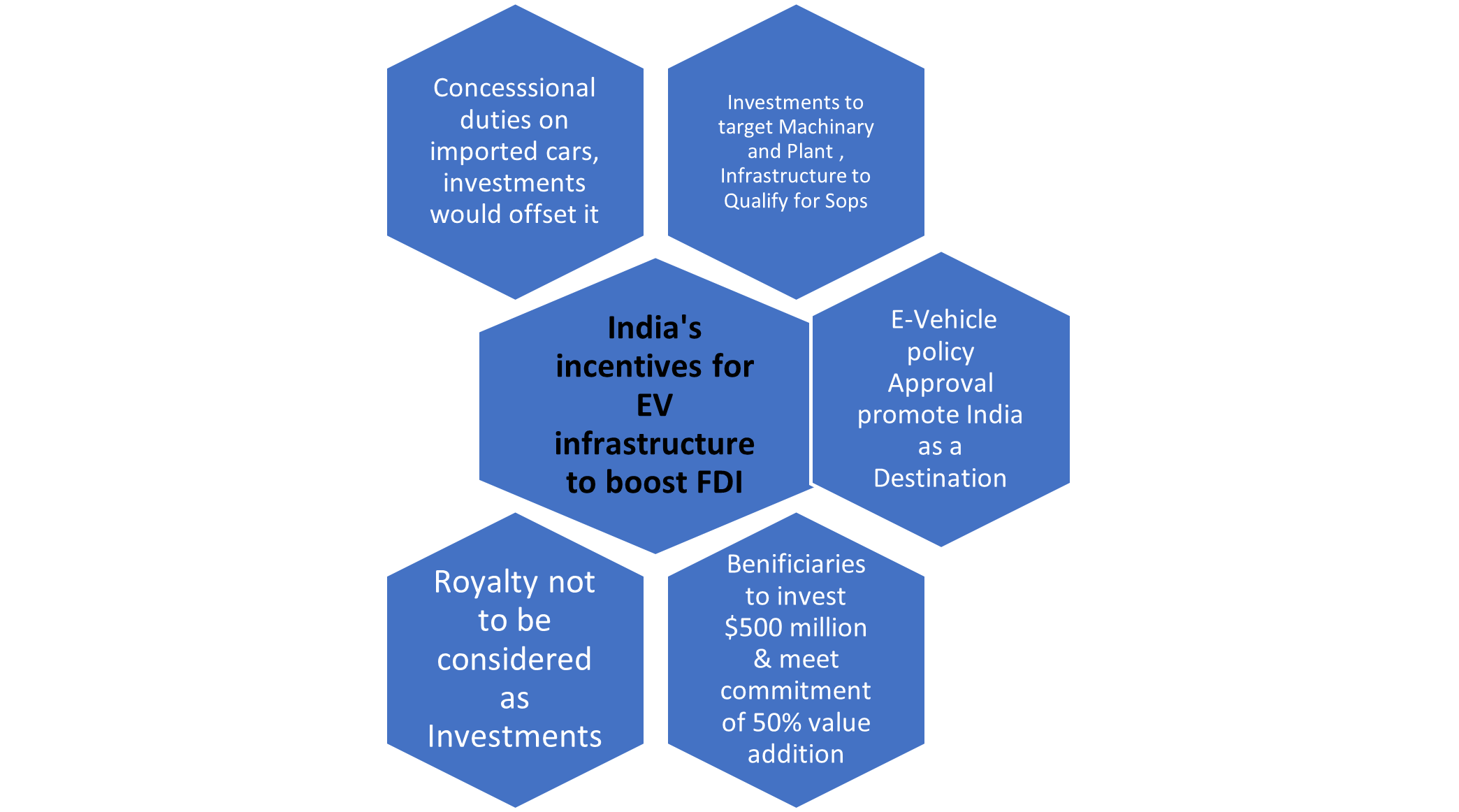
The Manufacturing of Electric Cars Scheme (SMEC), which was approved in March 2024, provides automakers building new greenfield EV manufacturing sites with reduced import charges. While establishing domestic production capacity, it permits manufacturers to import up to 8,000 EVs per year at reduced duties over a period of five years.
Production Linked Incentive (PLI) Scheme aims to encourage domestic production and draw in foreign investment, the government has extended the PLI scheme to include EV manufacturing which offers benefits to encourage investment, lower Goods and Services Tax (GST) rates for EVs and charging infrastructure, as well as exemptions from road charges, have been put into place. GST on electric vehicles has been dropped from 12% to 5%, while the GST on EV charging stations has been lowered from 18% to 5%. EVs are also eligible for green license plates and road tax exemptions to further drive adoption.
To promote India as a destination for e-vehicle manufacturing, the government has approved an e-vehicle policy. Businesses that establish e-vehicle production facilities will be permitted to import a limited number of cars at a reduced customs duty. Innovation in telematics, battery chemistry, and EV design is encouraged to satisfy the demands of export markets. Engineering and design facilities are promoted to modify Indian EVs for various road conditions and climates with global design centres. India's low-cost, effective domestic systems with sufficient software integration and feasible urban mobility allow it to take advantage of the export promotion opportunity with a range of EV-related products to be spanned across regions like ASEAN, South Africa, and Europe.
India’s scheme for EV promotion aims to reduce trade deficit, foster an era of innovation and reduce nation’s dependence on crude oil.
Source : UNCTAD
Road Ahead: Manufacturing Growth and Infrastructural Expansion
Sales of electric vehicles in India reached 1.52 million units in 2023, a 49.25% increase. The market is expected to increase at a compound annual growth rate (CAGR) of 66.52%, from USD 3.21 billion in 2022 to USD 113.99 billion by 2029. (Source: IBEF)
Different states are putting their own EV laws into effect. For example, Karnataka intends to electrify all three- and four-wheeler cargo trucks by December 2030, while Maharashtra wants to have 10% of all new vehicle registrations be EVs by December 2025.
It would be essential for the government to collaborate with the financial sector to direct funding towards more sustainable technologies and enterprises (such as EV Cell manufacturing projects), taking inspiration from the green finance commitments that the EU has obtained from regional banks like the European Investment Bank (EIB) and the European Bank for Reconstruction and Development (EBRD). Attracting greenfield project investments in specific high-priority, capital-intensive items like Cathode electric material, separators and copper foil would be greatly aided by this.
By 2030, India is expected to draw over USD 40 billion in EV-related investments, a large amount of which will go into the manufacture of lithium-ion batteries. One of the noteworthy investments is the USD 1.5 billion battery gigafactory that Tata Motors plans to build in India, with manufacturing anticipated to begin by 2026. Reliance New Energy's lithium iron factory in Gujarat and JSW Green Mobility's EV production facility in Maharashtra are some more noteworthy investments.
The Union Budget for 2025–2026 significantly increased funding for EV projects. The PM E-Drive Scheme's funding has been quadrupled to approximately USD 470 million in order to support domestic manufacturing and supply chain development, PLI for batteries and automotive components has increased by 713%.
Infrastructure for Charging: As of February 2024, Maharashtra has more than 12,000 public EV charging stations, more than any other state in the nation. The Confederation of Indian Industry (CII) estimates that by 2030, at least 1.32 million charging stations would be needed to handle such a giant EV fleet.
EV related Statistics 2023
|
Total EV Registrations: 759,182.
|
759182 |
|
States with EV Policies: |
25 |
|
EV Manufacturers Operating |
380 |
|
Reduction in CO2 emissions |
2656.62 kilotonnes |
|
Share of EV in total vehicle sales |
1.32% |
|
Charging Stations installed |
1800+ |
Source : Niti Ayog , 2023
Emerging Issues
High-power EV charging stations, especially quick chargers, can significantly increase the demand for electricity, putting stress on local systems. Impact: It may be required to make expensive upgrades to nearby feeder lines, substations, and distribution transformers. The power usage of a single Level 3 DC fast charger ranges from 50 to 350 kW, which is comparable to what a small commercial building would use.
The reliance on imported components, particularly from China for batteries and semiconductors, is a major barrier; therefore, establishing a robust domestic supply chain is essential for sustained success. Furthermore, the high cost of EVs remains a barrier to their widespread adoption, even in the face of government incentives. Infrastructure development must also be accelerated, particularly in rural areas, to handle the growing number of EVs.
Additionally, standards are important because they provide a means of sharing knowledge and transforming it into a public good. The economic efficiency of development is effectively increased when producers and developers can share lessons learned and tips gained. It is also important to remember that because EVs encompass a wide range of technologies with varying degrees of development, standardisation will need to play varied roles across the development spectrum.
Despite government incentives and subsidies, the high cost of EVs still prevents their widespread adoption, particularly among low-income and lower-class consumers. For EVs to be a viable option for the average person, their price must decrease. Although developing charging infrastructure is a key component of the strategy, its present implementation pace is inadequate, particularly in rural areas. If there isn't a reliable network of charging stations, potential buyers may be hesitant to switch to EVs because they are concerned about running out of electricity on long trips.
Way Forward
India is positioned for an electric vehicle transition that presents significant opportunities for global technology companies due to its governmental policies, rapid industrial expansion, and evolving ecosystem. India is building a strong foundation to speed up EV adoption and domestic manufacture thanks to the government's proactive approach through programs like FAME II, state-level EV laws, and PLI incentives. In addition to changing the automobile industry, this revolutionary change is creating opportunities for innovation, digitization, and sustainable mobility. Organizations must have a thorough knowledge of India's EV environment in order to support the nation's green transition and investigate scalable, high-impact commercial prospects as it develops into an important base for clean mobility.
Continually interacting with the corporate sector, academics, and foreign partners is essential for the government to handle new concerns and make necessary policy adjustments. With strong R&D base and skilled labour force for production of EV components and aim at transforming India a level playing field. Making appropriate modifications and keeping India on pace to become a worldwide leader in EV manufacturing would require constant monitoring and assessment.
Building high-tech EV element corridors along existing automobile belts in collaboration with governments is essential to achieving large-scale EV component production. First, adequate auto belts must be found, and suitable land must be set aside for the corridors' construction with the assistance of the relevant state governments. It is necessary to identify and onboard anchor investors and pertinent stakeholders. Plug-and-play manufacturing facilities and other shared infrastructure for the participants in the ecosystem must be installed in EV corridors.
With high capital requirements, financing support is essential to the establishment of a robust EV ecosystem. Finding partner banks is necessary to obtain green funding commitments for large-scale greenfield projects.
To expedite the establishment of Electronic Vehicle Supply Equipment (EVSE) manufacture and assembly in India, localization requirements are crucial. A committee will be established to go over the intricacies of the selection process and localization criteria. Mandates must be implemented while guaranteeing compliance with the specifics and conditions of the related tenders. Furthermore, investigating complementary technologies like hybrid cars and hydrogen fuel cells may give a well-rounded strategy for environmentally friendly transportation, providing substitutes that can coexist with EVs to accommodate a range of demands and road conditions.
With the help of encouraging legislation, rising investments, and developing infrastructure, India's EV market is expected to grow significantly. But issues like budget swings and the requirement for quick infrastructure construction still exist. To meet the challenging goals established for 2030, the government must continue to prioritise support and incentives for domestic manufacturing.
One of the key recommendations is to establish innovation laboratories that encourage the development of commercial products from lab prototypes and provide infrastructure for testing and prototyping. Build connections with other researchers to advance research and reduce barriers to commercialisation. Create a digital innovation platform to host R&D initiatives based on established priorities and involve interested parties to push the research agenda forward.
Sakshi Bhayana
Senior Assistant Professor,
Vivekananda Institute of Professional Studies, Technical Campus
References
Dhankhar, S., Sandhu, V., & Muradi, T. (2024). E-Mobility Revolution: Examining the Types, Evolution, Government Policies and Future Perspective of Electric Vehicles. Current Alternative Energy, 6(1), E24054631308595.
Haldankar, G. B., Bhat, S., Shirodkar, K. K., & Subramanyam, A. (2024). Electric vehicle revolution in India: a comprehensive and comparative study of EV business in India. International Journal of Energy Economics and Policy, 14(2), 150-159.
Brown, S., Pyke, D., & Steenhof, P. (2010). Electric vehicles: The role and importance of standards in an emerging market. Energy policy, 38(7), 3797-3806.
Haldankar, G. B., Bhat, S., Shirodkar, K. K., & Subramanyam, A. (2024). Electric vehicle revolution in India: a comprehensive and comparative study of EV business in India. International Journal of Energy Economics and Policy, 14(2), 150-159.
Singh, P., Kaur, I., Kumar, A., & Sahay, A. (2022). Accelerating the E-mobility revolution: A mixed-method enquiry into EV adoption behaviour. Available at SSRN 4119543.
https://www.niti.gov.in/sites/default/files/2023-07/Niti-Aayog_Report-VS_compressed_compressed.pdf
https://www.impriindia.com/insights/indias-e-vehicle-policy-2024/#google_vignette
Union Budget 2024 can draw a roadmap to spark India’s electric vehicle revolution. (2024, July 21). Economic Times
Press Release:Press information Bureau. (2024, March 15). PIB. Retrieved August 23, 2024
Muchhala, B. (2024). India – Introduces incentives for Electronic Vehicles (EV) infrastructure development to boost FDI | Investment Policy Monitor | UNCTAD Investment Policy Hub. Investment Policy Hub. Retrieved August 23, 2024
Bio Energy Times. (2024, March 15). Government approves EV policy to promote India as a manufacturing destination. Bio. Energy Times
Electric vehicles – IEA. (n.d.). International Energy Agency. Retrieved August 26, 2024
MUKHERJEE, S. (2024, July 8). Changes likely in India’s new EV policy, may benefit legacy car companies. The Economic Times. Retrieved August 23, 2024,
Ambika, A., Dharsaun, M. P., Priya, J. S., Porselvi, T., Nayanathara, C., & Thennarasu, S. (2024, October). Powering the EV Revolution: Charging Infrastructure Challenges and Innovations. In 2024 International Conference on Power, Energy, Control and Transmission Systems (ICPECTS) (pp. 1-6). IEEE.