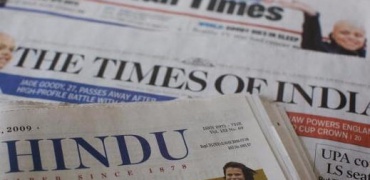
Rupee tumbles to record low of 92.30/USD amid Mideast war (Reuters)
Indian rupee fell to a record low of 92.30 per USD $ (INR), surpassing its previous trough of 91.98 in January, as the Middle East war rattled global markets. The Reserve Bank of India (RBI) is believed to have intervened to curb losses, with traders noting heavy pre‑market action to stabilize Asia’s worst‑performing currency. The rupee has already declined over 2% in 2026, following a 5% slide in 2025, making it one of the weakest among emerging markets. The sell‑off also hit equities, with the Nifty 50 index down nearly 2%, while the 10‑year bond yield rose 4 basis points to 6.717%, reflecting investor risk aversion. Analysts at Axis Bank and Kotak Mahindra Bank warned that India’s dependence on the Middle East for over 80% of crude oil imports and remittances could worsen the current account deficit, inflation, and GDP growth if the conflict persists. Meanwhile, Brent crude prices have surged 13% since the weekend, compounding external pressures and overshadowing optimism around a potential U.S.-India trade deal.
Analysts warn prolonged war could worsen India’s CAD and inflation (The Hindu Businessline)
The West Asia war and resulting oil shock have sharply increased currency hedging costs for Indian importers. Oil prices surged over 12%, reaching their highest level in nearly two years, which lifted dollar/rupee forward premiums and volatility expectations. One‑month implied volatility climbed to 5.6%, the highest since May 2025, while the implied interest rate on the one‑year dollar/rupee forward premium rose 8 basis points to 2.87%. This reflects heightened caution among importers, especially those in oil, gas, and commodity sectors, who rely heavily on hedging to manage foreign exchange exposure. The RBI is monitoring the situation closely, as the rupee has already weakened to 92/USD $ (INR), compounding risks for India’s current account deficit and inflation outlook. Analysts warn that prolonged disruptions in Middle East supply chains could further raise costs for importers and pressure India’s external balances.
China halts diesel, gasoline exports after Iran closes Hormuz (News18)
China’s suspension of diesel and gasoline exports after Iran closed the Strait of Hormuz has triggered global oil supply concerns with direct consequences for India. The order, issued verbally by the National Development and Reform Commission (NDRC) to major refiners Sinopec, PetroChina, and CNOOC, affects nearly 80% of China’s refining capacity and halts flows from Gulf suppliers that account for over 50% of China’s oil imports. Prices have already surged 15-20%, freight rates for large carriers have risen 3-5 times, and rerouting via Africa adds 2-3 weeks to delivery schedules. For India, the crisis is critical: the country depends on the Gulf for over 80% of crude oil imports and nearly all LPG supplies, yet has no strategic LPG reserves, leaving households exposed. Reports confirm 37 Indian‑flagged ships with 1,109 crew members stranded near Hormuz, while analysts warn that global diesel prices could rise 20-30%, worsening India’s current account deficit (USD $13.2B / INR ~1.1T in Q3 FY26) and inflation outlook. The Ministry of Petroleum and Natural Gas and Ministry of External Affairs will need to coordinate on diversifying supply routes and securing shipping lanes, as the conflict threatens both India’s trade balance and energy security.
India pushes tech transfer agenda at WTO MC14 in Cameroon (Economic Times)
At the upcoming World Trade Organization (WTO) Ministerial Conference (MC14) in Cameroon, March 2026, India has submitted a draft ministerial declaration urging developed nations to facilitate technology transfer to developing and least‑developed countries (LDCs). The proposal, highlighted by the Ministry of Commerce and Industry, stresses that barriers such as export controls on semiconductor chips and rare earth minerals, rigid intellectual property regimes under TRIPS, and high costs of access undermine equitable trade growth. India emphasized that LDCs face challenges in the acquisition, adaptation, and diffusion of advanced technologies, particularly environmentally sound technologies (ESTs), which are crucial for sustainable trade gains. The draft calls for developed members to share regional and sector‑specific technology needs, experiences, best practices, and funding mechanisms, while also examining WTO agreements on TRIPS, agriculture, technical barriers to trade, and sanitary and phytosanitary measures. India has proposed a time‑bound roadmap for operationalizing technology transfer commitments, noting that domestic capacity constraints in skills and infrastructure exacerbate global inequalities. This push aligns with India’s broader strategy to strengthen developing nations’ participation in global trade by ensuring fair access to critical technologies.